Few home improvement decisions impact your daily life quite like patio door selection. The door connecting your interior living spaces to your deck, patio, or yard influences natural light, indoor-outdoor flow, energy efficiency, and aesthetic character. For Massachusetts homeowners planning patio door replacement or new installation, the choice typically narrows to two primary options: sliding doors or French doors.
Both styles have evolved dramatically over recent decades. Modern sliding doors shed their 1970s reputation for drafty operation and builder-grade appearance, now offering sophisticated designs with impressive energy performance. French doors maintain their classic elegance while incorporating contemporary materials and insulation technology that previous generations couldn’t achieve. With over 20 years of construction experience and 8+ years specializing in door installation, First Light Windows and Doors has guided hundreds of Essex County homeowners through this decision.
The “right” choice depends entirely on your specific circumstances: available space, architectural style, lifestyle patterns, budget parameters, and personal preferences. This comprehensive guide examines every critical factor—space requirements, style impact, operational differences, energy performance, cost considerations, and maintenance demands. By understanding how each door type performs across these dimensions, you’ll make an informed decision aligned with your home’s needs and your family’s lifestyle.
Summary:
- Understanding the Fundamental Differences
- Space Requirements and Room Layout Considerations
- Style and Aesthetic Impact on Your Home
- Operation, Functionality, and Daily Use
- Energy Efficiency and Insulation Performance
- Cost Comparison: Installation and Long-Term Value
- Maintenance Requirements for Each Door Type
- Making Your Choice: Which Door Matches Your Needs?
- FAQ: Sliding Door and French Door Questions
Understanding the Fundamental Differences
Before examining specific performance factors, it’s essential to understand what fundamentally distinguishes these door types—both in construction and basic operation.
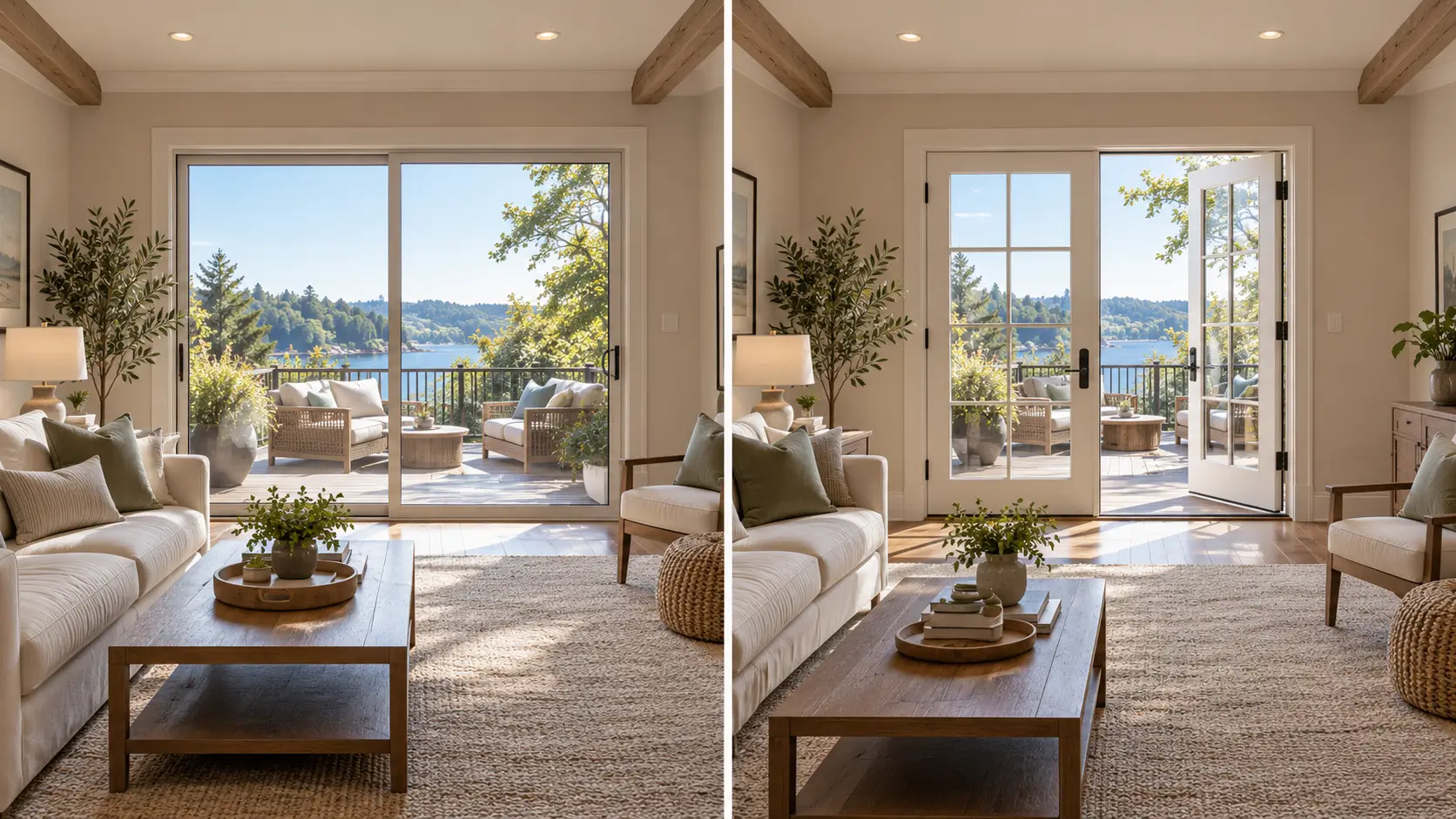
Sliding doors (also called sliding glass doors or patio sliders) consist of two or more large glass panels set in frames. One or more panels slide horizontally along tracks, parallel to the stationary panel(s). Most residential installations feature two panels with one operable and one fixed, though three- and four-panel configurations exist for wider openings. The panels ride on rollers in top and bottom tracks, requiring only horizontal force to operate.
The design maximizes glass area since structural support comes primarily from the perimeter frame. Sliding doors typically feature minimal visible frame, creating unobstructed views and maximum natural light transmission. Modern versions incorporate multi-point locking systems, anti-lift security features, and sophisticated weatherstripping that dramatically improves upon earlier generations’ energy performance.
French doors consist of two hinged door panels that swing open from a center point, similar to traditional double entry doors but typically with much larger glass areas. The doors meet at a center stile (vertical post), with one door typically holding the primary locking mechanism and the other secured with flush bolts to the header and threshold. When both panels open, they create a wide, unobstructed opening.
French doors feature visible center stiles where panels meet, creating the characteristic divided appearance that many homeowners find aesthetically appealing. This center meeting point requires careful weatherstripping and an astragal (the overlapping edge piece) to prevent air infiltration—more complex than sliding door sealing but highly effective when properly designed.
Both styles are available in various materials: vinyl, fiberglass, aluminum, and wood or wood-clad. Material choice influences performance, maintenance, and cost, but the fundamental sliding versus hinged operation remains the primary distinguishing characteristic affecting space requirements, style, and daily use.
Space Requirements and Room Layout Considerations
Space availability and room layout often determine which door type is practically feasible before aesthetic or cost considerations even enter the equation.
Sliding doors require minimal operational clearance—this represents their most significant practical advantage. Since panels slide parallel to the wall rather than swinging into space, no clear area is needed inside or outside for operation. Furniture can sit close to doors without interfering with function. Deck furniture, grills, or planters can be positioned near doors without blocking operation. This makes sliding doors ideal for rooms where space is tight or furniture placement leaves limited clearance near patio access.
Consider a family room with furniture arranged to maximize seating and viewing angles for television or conversation. Sofas, chairs, and tables often cluster near patio doors to take advantage of natural light and views. Sliding doors accommodate this close furniture placement, while French doors might require repositioning furniture several feet away to allow swing clearance—potentially compromising optimal room layout.
French doors need substantial swing clearance—typically 3-4 feet depending on door width. For doors swinging inward, this clearance must remain free of furniture and obstacles. For outward-swinging French doors (less common in residential applications), deck or patio space must accommodate the swing arc without interference from outdoor furniture, grills, or railings.
This clearance requirement isn’t merely inconvenient—it’s absolute. French doors physically cannot open if obstructed, unlike sliding doors that simply require moving a lightweight panel. Homeowners must maintain this clearance perpetually or sacrifice door functionality.
Room size and shape influence how burdensome this clearance becomes. In spacious rooms with generous square footage, dedicating 3-4 feet for door swing may not constrain furniture arrangement. In smaller rooms or irregular layouts, that same clearance might severely limit functional furniture placement.
Exterior considerations also matter. If your deck or patio is small, French doors swinging outward might conflict with furniture placement, grilling areas, or traffic flow. Sliding doors eliminate this exterior constraint entirely since they require no outdoor clearance.
For specific guidance on our sliding door replacement services and how we assess space requirements during consultations, visit our dedicated service page.
Style and Aesthetic Impact on Your Home
Door style powerfully influences your home’s interior and exterior character. Understanding each option’s aesthetic strengths helps align your choice with your design vision.
French doors embody traditional elegance and architectural refinement. The symmetrical dual-panel configuration with visible center stile creates formal, classic proportions that complement traditional home styles—Colonial, Cape Cod, Victorian, or Georgian architecture. When divided light patterns (grilles creating smaller panes) are incorporated, French doors reinforce period authenticity.
The doors’ operation—swinging open like welcoming arms—creates ceremonial quality that sliding doors can’t match. For homeowners who envision gracious indoor-outdoor entertaining or value traditional architectural details, French doors’ aesthetic impact justifies their higher cost and space requirements.
French doors also offer superior hardware visibility. Beautiful handle sets, decorative hinges, and elegant lock mechanisms become design features that enhance door appearance. These hardware elements integrate with interior design schemes, complementing door handles, cabinet pulls, and light fixtures throughout the home.
Sliding doors project contemporary, streamlined aesthetics. The horizontal lines, minimal visible frame, and emphasis on unobstructed glass create modern, clean-lined appearance that suits contemporary, mid-century modern, or transitional home styles. For homeowners prioritizing views, natural light, and seamless indoor-outdoor visual flow over traditional architectural detail, sliding doors deliver compelling advantages.
The absence of center mullion means uninterrupted glass expanses that frame views like picture windows. When both indoors and outdoors are visible simultaneously without vertical interruption, the effect enhances perceived space and connection to outdoor environments—particularly valuable for homes with scenic views, gardens, or carefully designed outdoor living spaces.
Sliding doors’ contemporary aesthetic also accommodates minimalist interior design approaches. The doors recede into background, allowing furnishings, art, and architectural features to command attention rather than competing with ornate door details.
Material and finish choices influence aesthetics for both door types. Warm wood tones create traditional, elegant character. White or painted finishes offer versatility suiting various styles. Dark bronze or black frames deliver bold contemporary statements currently trending in residential design.
For comprehensive guidance on matching doors to your home’s architectural style, see our detailed style guide covering material, color, and design considerations.
Operation, Functionality, and Daily Use
How doors function in daily life matters as much as how they look. Operation differences between sliding and French doors influence user experience, accessibility, and long-term satisfaction.
Sliding doors offer effortless single-hand operation. Quality modern sliders glide smoothly with minimal force—even children and elderly users operate them easily. The horizontal sliding motion feels intuitive and requires no coordination of multiple actions. This simplicity makes sliding doors particularly appealing for households with elderly residents, people with limited mobility, or young children who need independent outdoor access.
However, sliding doors limit opening width. When one panel slides behind the other, maximum opening equals roughly half the total door width. A standard 6-foot sliding door provides approximately 3 feet of clear opening—adequate for moving furniture occasionally or typical traffic but narrower than French doors’ full-width opening.
Ventilation control with sliding doors offers infinite adjustability. Slide the panel to any position for precise airflow control—from narrow crack to maximum opening. This flexibility allows fine-tuning ventilation to match weather conditions and comfort preferences.
French doors require two-hand operation for full opening—releasing locks, turning handles, and swinging both panels. This multi-step process is less convenient for frequent passage but creates dramatic wide-open effect for special occasions. The coordinated action required may challenge users with limited mobility or strength.
When both panels open, French doors provide wider unobstructed access than comparable sliding doors—the full opening width minus only the narrow stile width. This proves advantageous for moving furniture, hosting large gatherings where traffic flows freely between indoor and outdoor spaces, or creating maximum openness for entertaining.
French doors’ swing operation also enables single-panel opening for normal daily use while reserving full opening for special needs. This flexibility allows convenient access without always opening both panels—similar to using a single door for daily traffic through double entry doors.
Screen integration differs significantly. Sliding doors accommodate screens easily—either a sliding screen panel that mirrors door operation or a retractable screen system. Screens remain constantly available without removing or storing.
French doors require retractable screens or removable panel screens since swing operation prohibits fixed screens. Retractable screens (higher cost) hide when not needed and deploy when doors open. Traditional removable screens require seasonal installation and storage—inconvenient but functional.
Energy Efficiency and Insulation Performance
Energy efficiency directly impacts comfort and operating costs throughout your home’s life. Understanding performance differences helps evaluate long-term value beyond initial purchase price.
French doors achieve slightly better insulation values when comparing quality products. The compression weatherstripping created when French doors close—with one door pressing against the astragal and frame—creates exceptionally airtight seal. Multi-point locking systems pull doors tightly against weatherstripping along their entire height, minimizing air infiltration. Quality French doors routinely achieve U-factors of 0.25-0.30, indicating excellent insulation.
The hinged operation also means no tracks requiring gaps for panel movement. Every edge can be tightly sealed against weatherstripping without accommodation for horizontal sliding, eliminating a potential infiltration pathway that sliding doors must address.
Sliding doors require more sophisticated engineering to achieve comparable efficiency. The bottom track particularly challenges weatherproofing since the panel must slide freely while maintaining seal. Modern premium sliding doors address this through advanced weatherstripping designs, pile seals that compress when doors close, and multi-point locking systems that pull panels tight against seals.
Quality sliding doors now achieve U-factors of 0.28-0.32—approaching French door performance and dramatically improved over older slider generations. The performance gap has narrowed substantially as manufacturers refined designs specifically to address sliding doors’ historical efficiency weaknesses.
Both door types benefit from low-E glass coatings, argon gas fills, and insulated frames that comprise modern energy-efficient door construction. These features matter more than door type—a premium sliding door with advanced glazing outperforms a basic French door with standard glass.
Massachusetts climate creates demanding performance requirements. Cold winters test insulation and air-sealing. The heating season spans October through April, making door energy performance a seven-month annual concern. Even modest efficiency differences compound over decades of ownership.
Consider the long-term cost implications: A door with U-factor 0.28 versus 0.32 might seem trivial, but over 25-30 years of New England heating seasons, the cumulative energy cost difference can reach several hundred dollars. This narrows or even eliminates initial price differences between door types.
Professional installation matters enormously for energy performance—more than nominal product specifications suggest. Perfectly specified doors installed poorly perform worse than modest doors installed expertly. Our exterior door installation emphasizes weatherproofing and air-sealing because we recognize installation quality determines real-world performance.
Cost Comparison: Installation and Long-Term Value
Budget realities influence most home improvement decisions. Understanding both upfront costs and long-term ownership expenses helps evaluate which door delivers better overall value for your specific situation.
Sliding doors typically cost less initially. A quality 6-foot vinyl or fiberglass sliding door unit ranges from $800-1,800 for the door itself (before installation), depending on features, glass package, and finish quality. Premium models with advanced energy features, upgraded hardware, and superior aesthetics reach $2,000-3,000.
French doors generally cost 15-25% more than comparable sliding doors. Similar-quality 6-foot French door units range from $1,200-2,400, with premium options reaching $3,000-4,000. The cost premium reflects more complex hardware (hinges, multi-point locks, flush bolts, astragals), increased labor for precise installation ensuring proper swing and weatherproofing, and typically more extensive weatherstripping requirements.
Installation costs vary based on project complexity but generally run comparable for both door types—$400-800 for straightforward replacement installations. French doors sometimes incur slightly higher installation costs due to more complex hardware installation and weatherproofing requirements, but differences are modest compared to door cost itself.
Existing opening modifications affect total project cost more than door type. If your current opening requires enlargement, structural header upgrades, or extensive trim work, these costs (often $500-2,000) dwarf the door price difference between sliding and French options.
Long-term value considerations shift the equation. Sliding doors’ lower initial cost appears attractive, but maintenance costs over 20-30 years—track replacement, roller upgrades, more frequent weatherstripping replacement—can narrow the lifetime cost gap. French doors’ simpler operation mechanism (hinges versus rollers and tracks) sometimes proves more durable, though this varies by product quality and usage patterns.
Energy savings represent another long-term value factor. French doors’ slight efficiency advantage might save $15-25 annually in heating costs compared to basic sliding doors. Over 25 years, this $375-625 in cumulative savings partially offsets their higher purchase price.
Resale value impact is modest and market-dependent. Both styles add value compared to deteriorated old doors, but French doors occasionally command slight premiums in markets where traditional aesthetics dominate buyer preferences. The difference rarely exceeds a few hundred dollars in home value—insufficient to drive decision-making versus functional and personal preference factors.
Maintenance Requirements for Each Door Type
Long-term maintenance demands influence total ownership cost and user satisfaction. Understanding each door type’s maintenance needs helps set realistic expectations.
Sliding doors require track maintenance as their primary ongoing need. Bottom tracks accumulate dirt, debris, and dust that interfere with smooth operation. Monthly vacuuming or brushing of tracks prevents buildup. Neglected tracks cause binding, difficult operation, and accelerated roller wear. This maintenance takes only minutes but requires discipline to maintain consistently.
Roller maintenance also proves critical for sliding door longevity. Even quality rollers eventually wear, causing doors to drag or operate roughly. Periodic lubrication extends roller life, but eventual replacement (every 10-15 years for quality doors) is common. Roller replacement typically costs $150-300 including labor—a modest expense but one sliding door owners should anticipate.
Weatherstripping on sliding doors experiences constant friction from panel movement. This abrasion causes faster degradation than French door weatherstripping. Plan for weatherstripping replacement every 7-10 years to maintain optimal energy performance. Professional replacement costs $200-350, or motivated DIYers can tackle this project with patience.
Screen maintenance for sliding doors involves track cleaning for the screen panel and occasional screen material replacement if torn or damaged. Retractable screens require more sophisticated maintenance but manufacturers design them for minimal service requirements.
French doors need hinge maintenance as their primary mechanical concern. Annual lubrication with silicone spray or light oil keeps hinges operating smoothly and prevents squeaking. This simple maintenance takes minutes and prevents premature hinge wear. Hinge replacement, if eventually needed, costs $100-250 including labor.
Weatherstripping inspection for French doors should occur annually. Check compression seal contact, astragal condition, and threshold sweep integrity. Unlike sliding doors where weatherstripping experiences friction wear, French door seals typically last longer—often 10-15 years before replacement becomes necessary.
Multi-point lock mechanisms require occasional lubrication and adjustment. As houses settle over years, door alignment may shift slightly, requiring minor hinge adjustment to ensure locks engage properly. Most homeowners can handle simple adjustments; complex issues warrant professional attention.
Both door types benefit from regular glass cleaning, frame washing, and general inspection for any developing issues. Catching small problems early—a minor crack in glazing, slight weatherstripping gap, or hardware looseness—prevents major repairs later.
Material choice influences maintenance beyond door type. Vinyl frames require minimal maintenance beyond cleaning. Wood or wood-clad doors need periodic refinishing every 3-5 years on exterior surfaces to prevent weather damage. Fiberglass frames offer low maintenance similar to vinyl. Aluminum frames practically never need refinishing but may show oxidation over time.
The maintenance burden difference between door types is real but manageable. Homeowners willing to invest 15-20 minutes quarterly for preventive maintenance will find either door type performs reliably for decades. Those who neglect maintenance may experience problems with either style—sliding doors through track/roller issues, French doors through hinge and weatherstripping deterioration.
Making Your Choice: Which Door Matches Your Needs?
With comprehensive performance information across all critical factors, you can now align door selection with your specific priorities, home characteristics, and lifestyle needs.
Choose sliding doors if you:
- Have limited interior or exterior space near the door location
- Furniture placement requires positioning close to patio access
- Prioritize easy single-hand operation and accessibility
- Prefer contemporary, streamlined aesthetics
- Face tighter budget constraints (10-20% cost savings versus French doors)
- Want maximum unobstructed glass and views without center mullion
- Don’t need full-width opening for regular use
- Prefer lower-profile hardware that doesn’t dominate door appearance
Choose French doors if you:
- Have adequate space for 3-4 foot door swing clearance
- Value traditional architectural elegance and classic proportions
- Frequently host gatherings requiring wide indoor-outdoor access
- Want maximum opening width for moving furniture or flowing traffic
- Appreciate decorative hardware as a design element
- Own traditional home style (Colonial, Cape, Victorian) where French doors complement architecture
- Prioritize absolute maximum energy efficiency (slight advantage)
- View doors as architectural focal point rather than background element
Either door works well if you:
- Seek dramatic improvement over current deteriorated door
- Want professional installation ensuring optimal energy performance
- Value quality manufacturer warranties and proven product lines
- Need standard sizes readily available from multiple manufacturers
- Can accommodate professional installation timeline (similar for both types)
- Prioritize security features (both achieve excellent security with quality products)
Geographic and site-specific factors also influence optimal choice. Homes with spectacular views benefit from sliding doors’ uninterrupted glass. Properties with expansive decks may prefer French doors’ full-opening entertaining advantages. Exposed locations with strong prevailing winds might favor French doors’ superior compression weathersealing.
Consider your household’s specific usage patterns. Families with frequent indoor-outdoor traffic during warm months might appreciate sliding doors’ ease of operation. Homeowners who primarily open doors for special occasions rather than daily use may prefer French doors’ dramatic effect despite multi-step operation.
Think long-term about changing needs. As homeowners age, sliding doors’ accessibility advantages become more valuable. If you plan decades-long ownership, prioritize features that accommodate changing mobility over purely aesthetic considerations.
For personalized guidance based on your home’s layout, your style preferences, and your specific usage requirements, discuss your patio door options with our team. Two decades of construction experience and specialized door installation expertise ensure you receive honest, transparent guidance—helping you choose the door that truly matches your needs, not just the one with the highest profit margin.
FAQ: Sliding Door and French Door Questions
Which door type provides better energy efficiency—sliding or French?
Modern French doors with quality weatherstripping slightly outperform sliding doors for insulation because they use compression seals that create airtight closure. However, premium sliding doors with multi-point locking and advanced weatherstripping achieve comparable efficiency. The difference is minimal—both offer excellent energy performance when professionally installed.
Do sliding doors take up less space than French doors?
Yes, significantly. Sliding doors require no interior or exterior clearance for operation—panels slide parallel to the wall. French doors need clear swing radius (typically 3-4 feet) for operation. This makes sliding doors ideal for tight spaces, rooms with furniture near the door, or decks/patios with limited clearance.
Are French doors more expensive than sliding doors?
French doors typically cost 15-25% more than comparable sliding doors due to more complex hardware (hinges, multi-point locks, astragals), increased weatherstripping requirements, and more labor-intensive installation. Premium sliding doors can approach French door pricing, but at comparable quality levels, French doors generally cost more.
Which door style adds more value to a home?
Both add value, but French doors often command slight premium in perceived elegance and traditional appeal. The value difference is modest—your choice should prioritize functionality and style preference over resale considerations. Proper installation and quality products matter more than door type for value impact.
Can sliding doors be as secure as French doors?
Yes, when equipped with modern security features. Quality sliding doors include anti-lift devices, multi-point locking systems, and reinforced frames that provide excellent security. French doors’ hinges and locking astragals also provide strong security. Both achieve comparable protection when you select quality products and professional installation.
Which door type requires more maintenance?
Sliding doors require track cleaning and roller maintenance to ensure smooth operation—plan for track vacuuming monthly and occasional roller lubrication. French doors need hinge lubrication and weatherstripping inspection but no track maintenance. Overall maintenance burden is comparable, just different focus areas.
Do sliding doors provide as much light as French doors?
They can provide more. Sliding doors often feature larger glass areas since structural support comes from frame perimeter rather than central mullion. French doors include center stile where doors meet, slightly reducing glass area. The difference is modest, and both flood interiors with natural light.
Do sliding doors provide as much light as French doors?
French doors create wider unobstructed openings when both panels open, ideal for flowing indoor-outdoor gatherings. Sliding doors limit opening width to roughly half the total door width (one panel slides behind the other). For maximum opening and entertaining flexibility, French doors provide advantages.